
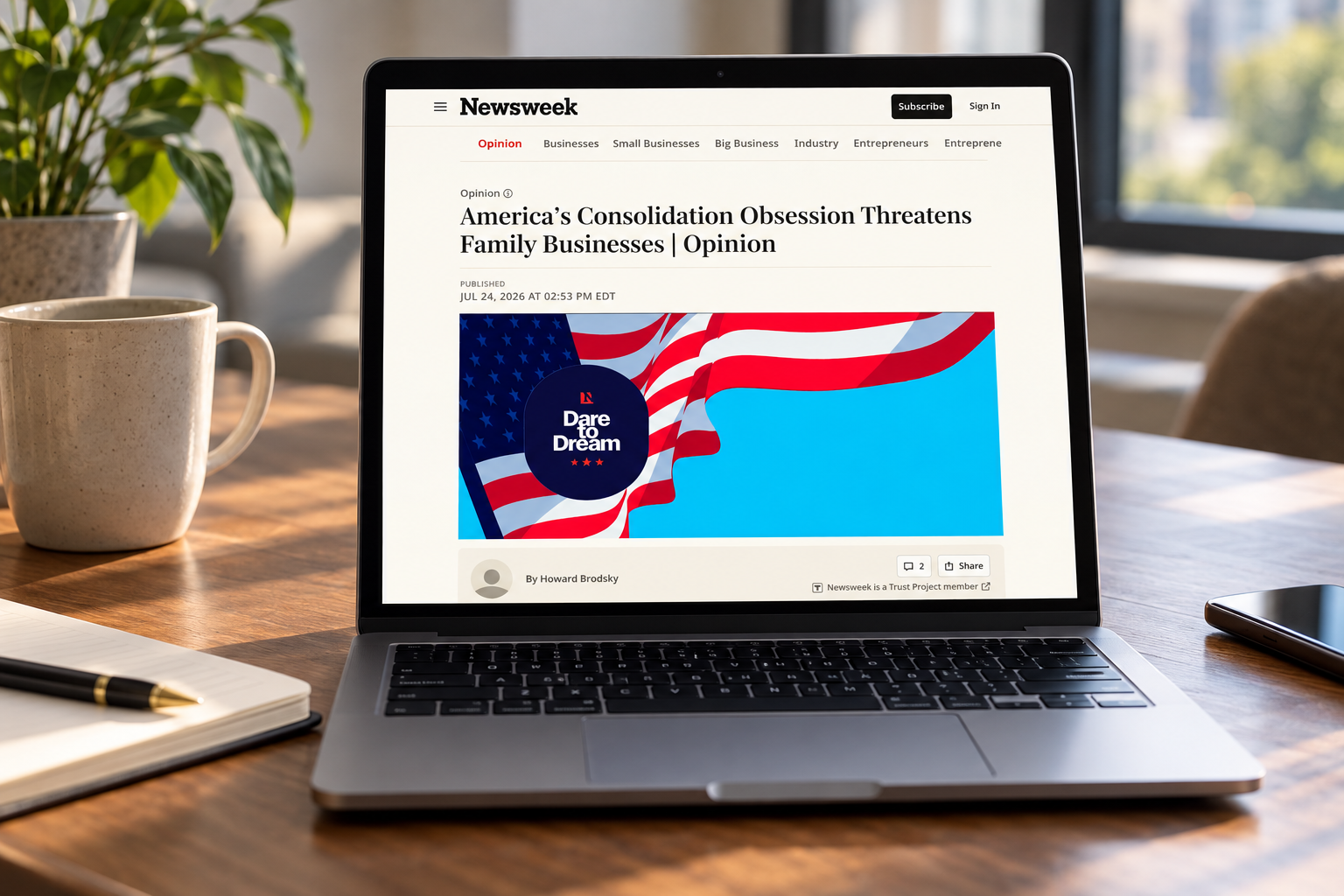
I recently wrote in Newsweek about a question I believe deserves much more attention: why have we come to accept consolidation as the inevitable price of competitiveness?
As artificial intelligence, cybersecurity and other technologies make scale increasingly important, independent and family-owned businesses face very real pressure to get bigger—or be acquired. But I don’t believe those are the only choices. There are ways for businesses to achieve the advantages of scale while preserving their independence, ownership and connection to the communities they serve.
That is the argument I make in this piece, originally published in Newsweek. I’m sharing it here in full as part of The Cooperative Lens.
But I’d also like to hear what you think: Is consolidation really inevitable as the cost of competing continues to rise? Or can shared ownership and cooperation give independent businesses another path to scale? I hope you’ll read the piece and join the conversation.

America’s Consolidation Obsession Threatens Family Businesses
by Howard Brodsky
Every time an American industry comes under pressure, we reach for the same solution. A regional bank struggles? Merge it. A hospital can’t keep up with rising costs? Acquire it. A family-owned retailer falls behind technologically? Sell it. We’ve become so accustomed to consolidation that we rarely stop to ask whether it’s actually solving the problem. Instead, we’ve convinced ourselves that bigger is always better and every merger is another sign of progress.
I think we’ve accepted one of the most damaging assumptions in modern business. America doesn’t simply have a competitiveness challenge. It has a consolidation problem.
For decades, we’ve celebrated consolidation as though it were synonymous with innovation. We’ve praised larger companies for their efficiency, their scale and their ability to dominate markets. But somewhere along the way, we stopped measuring what we were losing in return. That should concern all of us because America’s economy still depends overwhelmingly on independent businesses.
Today, more than 36 million small businesses account for 99.9 percent of all U.S. businesses and employ nearly 46 percent of the private-sector workforce. Yet every acquisition that removes another family business from the marketplace doesn’t simply change a balance sheet. It changes a community. It reduces consumer choice. It concentrates decision-making further away from the people most affected by those decisions.
We’ve mistaken concentration for strength.
That mistake has become even more dangerous because artificial intelligence is reshaping the competitive landscape faster than almost any technological shift before it. Businesses today aren’t simply competing on products or customer service anymore. They’re competing on artificial intelligence capabilities, cybersecurity, cloud infrastructure, digital transformation and increasingly sophisticated data systems. Those investments require enormous resources, and the cost of staying competitive continues to rise.
It’s no surprise that many people now believe another wave of consolidation is inevitable. I don’t. Technology should create more competitors, not fewer. The promise of AI should be to democratize capability, not concentrate power. If AI simply accelerates the disappearance of independent businesses, then we will have mistaken technological progress for economic progress.
Those are not the same thing. The real challenge isn’t helping businesses become bigger. It’s helping them become competitive without disappearing.
Unfortunately, our thinking about growth has become trapped between only two options. Either a company acquires another, or it gets acquired. Either ownership expands through acquisition, or ownership disappears through acquisition. We’ve built an economy that increasingly assumes competitiveness requires surrendering independence.
Why should entrepreneurs spend decades building successful companies just to conclude that their only path forward is selling what they spent a lifetime creating?
We’ve spent decades innovating products. We’ve revolutionized manufacturing, logistics, communications, software and now artificial intelligence. Yet we’ve devoted remarkably little creativity to innovating the way businesses themselves compete.
I believe that’s where the next breakthrough needs to happen.
The future doesn’t belong only to the companies with the deepest pockets. It belongs to the organizations that find smarter ways to achieve scale without sacrificing independence. Scale matters more today than perhaps at any point in modern business history. AI, cybersecurity, procurement, technology infrastructure, compliance and digital investment have made that unavoidable.
But scale and ownership are not the same thing. Somewhere along the way, we began treating them as if they were inseparable.
They aren’t.
I believe businesses should be able to share purchasing power, technology investments, AI capabilities, expertise and operational infrastructure without surrendering the ownership that makes them unique. Shared ownership business models offer exactly that possibility. They allow independent organizations to compete with the strength of something much larger while preserving the entrepreneurial spirit, local accountability and long-term commitment that have always distinguished family businesses from distant corporate headquarters.
That distinction matters because family businesses don’t simply think differently about ownership. They think differently about responsibility. Their customers are often their neighbors. Their employees are members of the same community. Their success is measured not only by the next earnings report but by whether they’ll still be serving those communities decades from now.
The question we should be asking isn’t whether America needs scale. We absolutely do. The question is why we’ve come to believe that scale must always require giving up ownership in the first place.
Nearly 40 percent of CEOs believe their businesses will not remain economically viable over the next decade without significant reinvention. I agree that reinvention is necessary. Where I disagree is on what reinvention actually means.
For too long, we’ve assumed that reinvention requires larger companies, fewer competitors and more concentrated ownership. I believe the opposite is true. The next chapter of American business shouldn’t be defined by how many companies we can combine under one corporate umbrella. It should be defined by how many independent businesses we can equip to compete without giving up what made them successful in the first place.
Shared ownership business models deserve to be part of that conversation, not because they’re an alternative to capitalism, but because they reinforce what has always made capitalism work at its best: competition, entrepreneurship, local accountability and the freedom to build something that lasts beyond the next earnings report.
If we continue treating consolidation as the only road to competitiveness, we won’t simply end up with fewer businesses. We’ll end up with fewer entrepreneurs willing to take risks, fewer family businesses able to pass their legacy to the next generation, fewer local leaders investing in the communities they call home, and an economy that becomes increasingly resilient for the largest companies while becoming increasingly fragile for everyone else.
I don’t believe that’s the future Americans want. The question isn’t whether businesses need scale. Artificial intelligence, cybersecurity and the pace of technological change have already answered that. They do.
The question is whether achieving scale must always come at the cost of independence.
I believe we’ve spent decades reinventing technology. It’s time we started reinventing the way businesses grow. Because if the only way to compete is to sell, then we’ve confused consolidation with progress. And history will remember that as one of the costliest business mistakes America ever made.
Originally published in Newsweek, July 24, 2026.
To read the original article on Newsweek click here.
0 Comments