
Finding a place for cooperatives across the whole AI value chain
How does the cooperative economy navigate the turbulence that comes with AI—and help shape where it takes us?
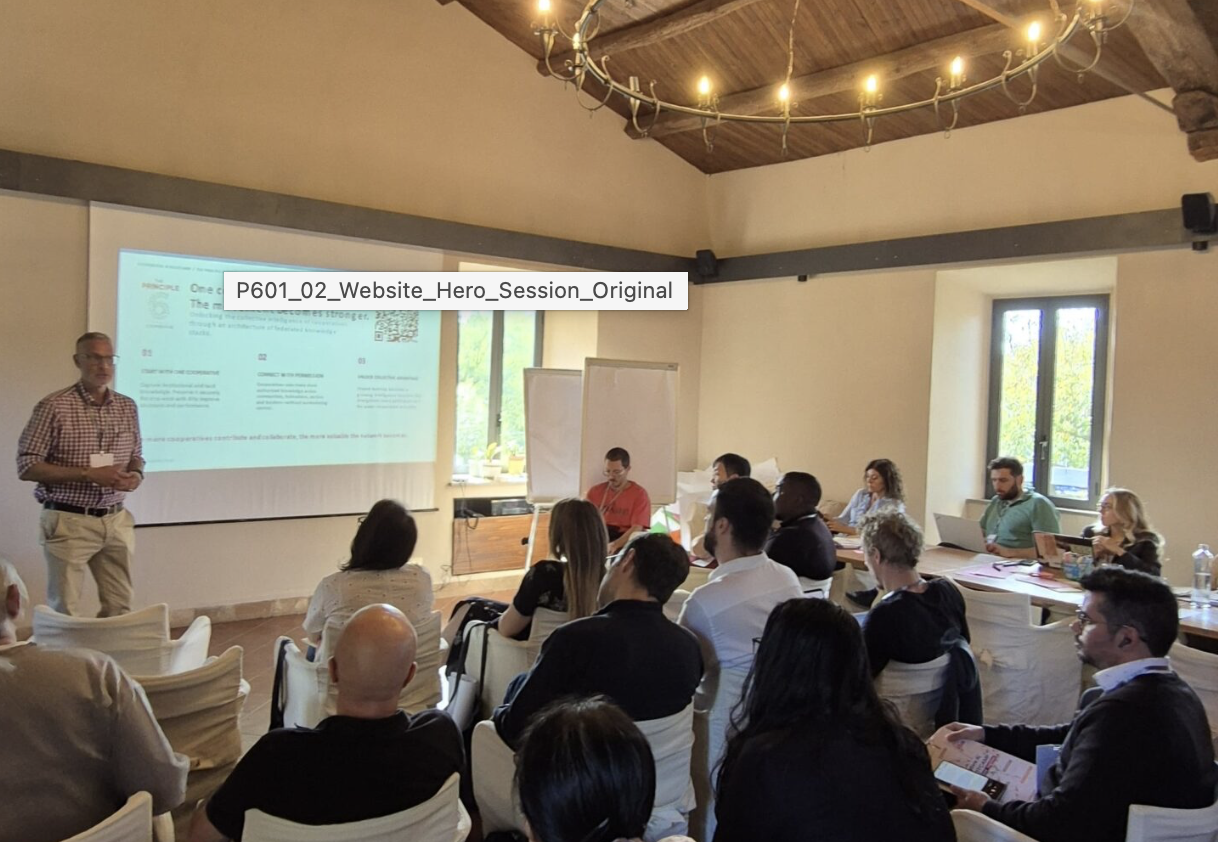
That was the bigger question behind the Cooperative AI Bootcamp in Rome. AI could change the work our members do, the services cooperatives provide and the businesses we compete with. We need to understand those changes and prepare for them. We also need to ask where cooperatives could have ownership and a real say in the system being built.
Justin Hammons participated through The Principle 6 Cooperative. We’re grateful to the International Cooperative Alliance, Legacoop and Fondazione PICO for bringing the gathering together, and to the participants for sharing their experience and ideas.
Rome was about getting people from across the cooperative economy thinking and talking. Looking at AI together gave people with different backgrounds a place to compare perspectives, ask questions and begin imagining what a cooperative role could look like.
AI begins long before the chatbot
For many of us, AI starts with typing a question into a box. But that box is the visible end of a much larger system. Understanding it means following the AI value chain: the materials, work and technology that make AI possible, and the businesses and institutions behind them.
It begins with mining and processing the minerals used in hardware, then designing and manufacturing chips and other equipment. Data centres house the computers. Electricity, cooling and communications networks keep them running and connected.
Then come the data used to train models, the people doing that work and the choices about how models are designed. A model’s architecture is its underlying design. Along with its training, it helps shape what the model can do. Applications and services bring those capabilities into our workplaces and daily lives.
The Rome programme asked participants to examine these parts of AI and the actors shaping them. That gives us a wider view of where decisions are made, who benefits and where cooperative approaches might make a difference.
Where could cooperatives own a part of that system
Once we see the whole picture, different questions open up.
Could cooperative mining or mineral-processing enterprises give workers and communities a stronger say in how materials are sourced and the benefits shared? What would responsible participation look like for the people and places affected?
Could cooperatives own more of the infrastructure, such as data centres, communications networks or the energy that powers them? Could shared ownership help cooperatives get access to computing resources on terms they have a say in setting?
And what about the models themselves? How could their design and training reflect more languages, communities and cooperative experiences? How could contributors have a say in how their knowledge is used and share in the value it creates?
Do we need to build a cooperative AI model of our own? Could we adapt existing models, or combine different approaches? Those choices need to be explored. They lead to a larger question: where could cooperative ownership take root across the value chain, and could those efforts eventually connect across the whole system?
Navigate the changes and help set the direction
Cooperatives still need practical help choosing useful tools, supporting staff and understanding risks. That is part of navigating the changes AI may bring. But we should also consider the decisions that shape the choices available to us.
If cooperatives depend on systems they have little influence over, they may have limited control over prices, access and what happens to the value their members help create. Ownership could give them more influence, provided it comes with real member control and fair treatment of workers and communities.
A cooperative name alone won’t settle those questions. We would need to examine how decisions are made, whose voices are heard and whether the benefits reach the people contributing to the system.
A seat at the table
Rome gave that conversation a starting point. For P6, the wider challenge is to bring the cooperative economy into the global discussion about AI, with enough understanding to ask useful questions and contribute ideas of our own.
That means contributing to decisions about investment, technology and the rules that will affect our members. It also means exploring where we could build, own or govern parts of the system together. The Bootcamp opened space for that work; the questions above remain questions for us to examine.
Join the discussion
Where in the AI value chain could cooperatives make the greatest difference, and what would help us get there? Bring your perspective on ownership, participation or the changes affecting your cooperative to the P6 Collaborative Community: {{P601_DISCUSSION_URL}}.
Explore P6 and CoopAI
New to P6? Read the CoopAI overview or watch the CoopAI Explainer to explore our approach.
Read our Presentation Deck.
0 Comments